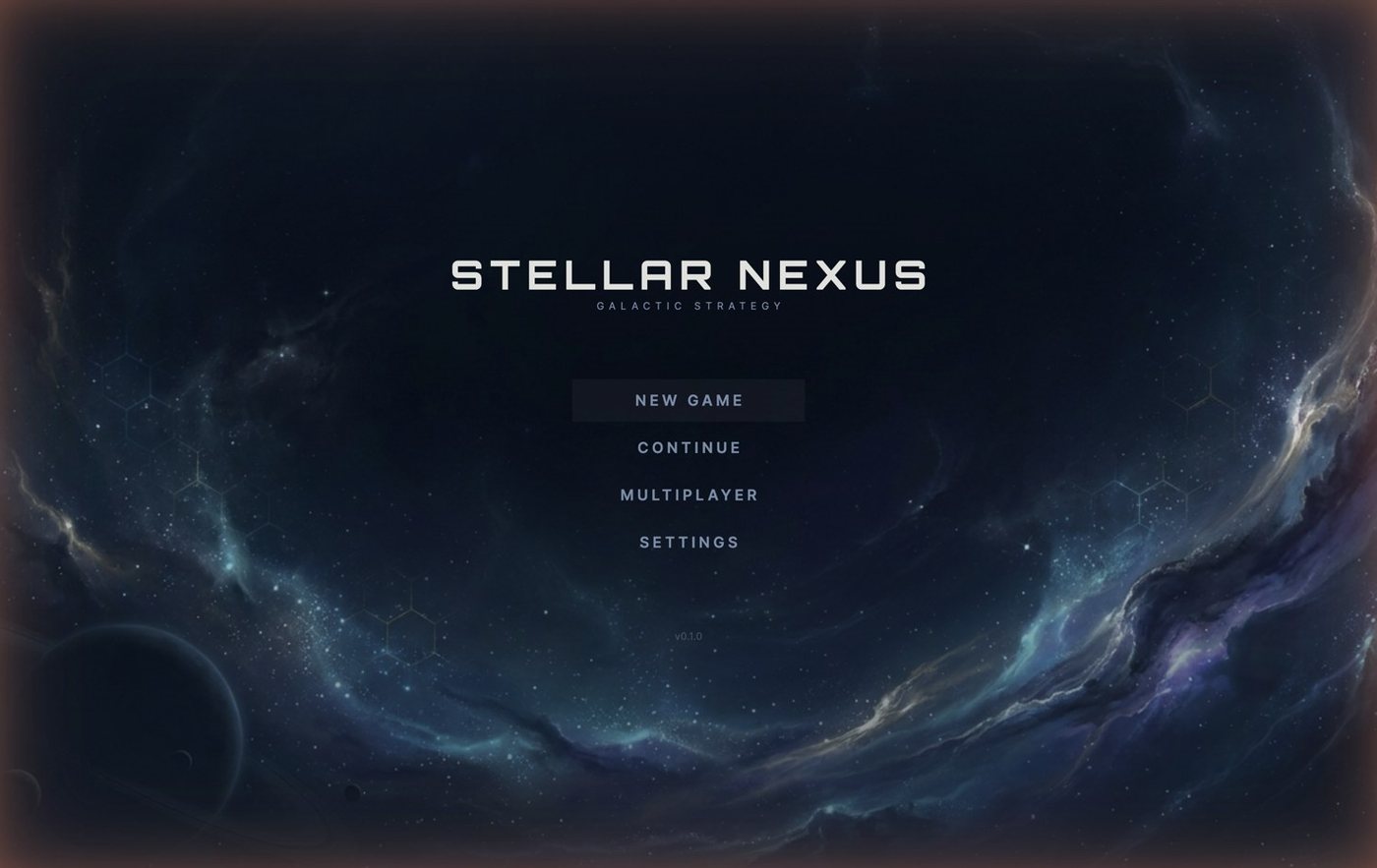
Stellar Nexus is a 4X strategy game built on three principles:
Asynchronous play. Submit your turn, walk away, come back. Multiplayer doesn’t ask everyone to be online at the same time — it asks everyone to have submitted their orders by the deadline. Real life happens; the galaxy waits.
Asymmetric factions. Four civilisations with different starting fleets, different bonuses, and different paths through the mid-game. The Terran Directorate plays nothing like the Nyx Collective. Pick the one that matches how you like to think.
Strategic depth without bloat. Eight resources, six ship classes, four factions, dozens of techs and buildings. Enough complexity to reward planning. Not so much that a single turn takes an hour.
The game is in active development. The interface is an early prototype, and most systems are still being polished. See the roadmap for a current snapshot of what’s playable.
What makes it different
Six things worth knowing
The claims, with the detail behind them rather than instead of it.
- 01
Async multiplayer, in development
Async multiplayer is in development, not a public mode. The goal is a turn-by-turn game where a central service resolves a round after every player submits and returns each player only their own view.
- 02
Asymmetric factions, not skinned ones
Four civilisations with hand-tuned bonuses, opening fleets and complete research paths. The Terran Directorate builds industrial command networks. The Nyx Collective compounds discovery. Orion Hegemony feeds fleet supremacy. Vanguard Nomads connect exploration, exchange and influence.
- 03
Depth without bloat
Eight resources to balance, six combat ship classes to compose, a research-gated City-Ship to deploy or relocate, and faction technology trees spanning military, economy, exploration, diplomacy and special projects. The early tactical-turn work now checks each ship group’s weapon reach and clear firing line, while current ships retain one-tile range. Branch filters keep the choices readable, while shared foundations leave room to pivot.
- 04
One click to a fresh galaxy
Quick Play drops you straight into a small galaxy against a single rival — a new map every time, no configuration screen. It is the fastest way to learn the loop, and the full setup flow is right underneath when you want a bigger war.
- 05
Campaign finishes in the development build
The current development build supports conquest, scientific, diplomatic, and economic campaign outcomes. Balance, release readiness, and the public launch are still in progress.
- 06
Plays on any screen
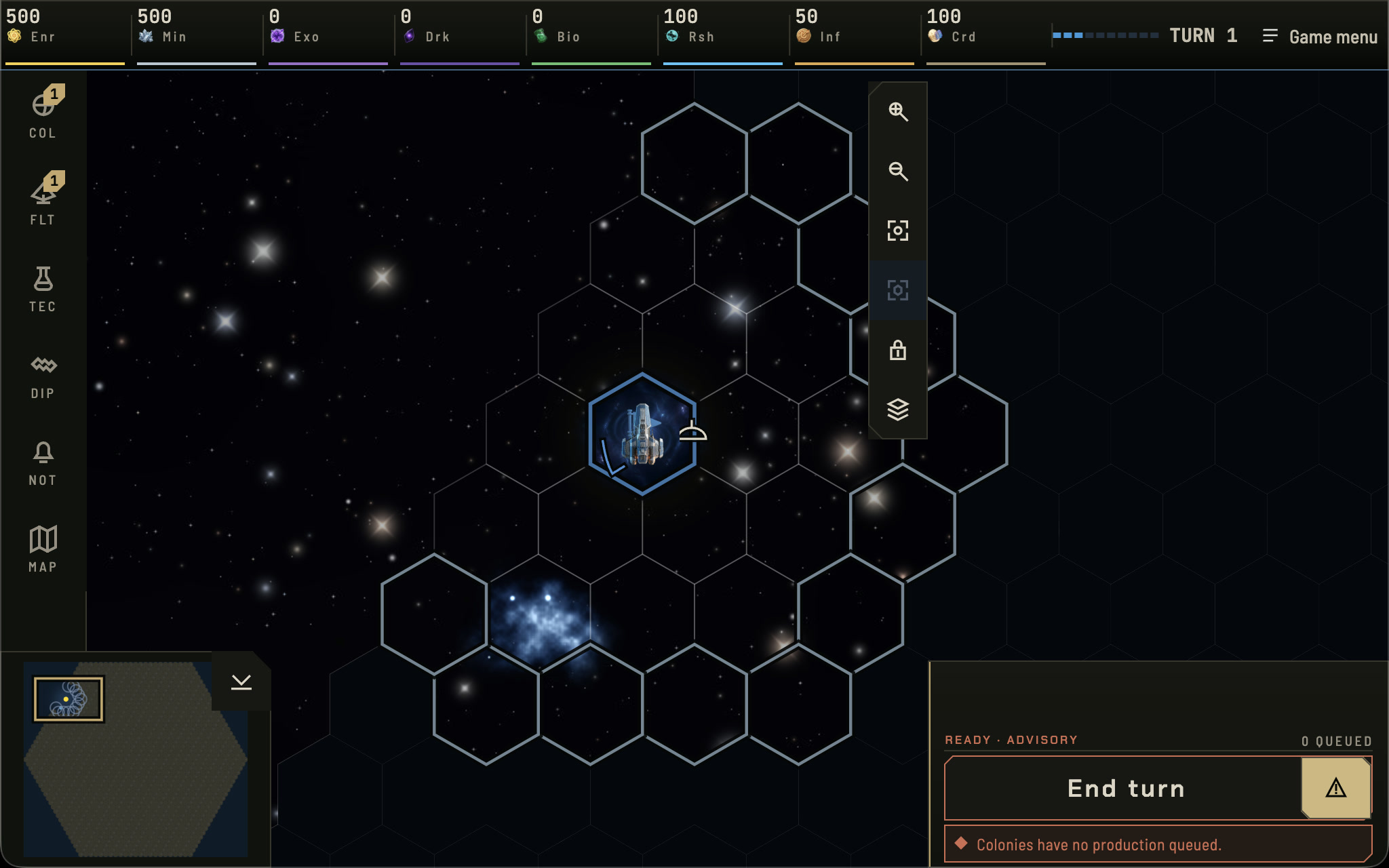
The galaxy map reaches every edge, with navigation and empire status resting above it instead of shrinking the playfield. One continuous strip keeps resources and shortages easy to scan; on a phone it brings the resources that need attention into view first and tells you how many more are waiting. Panels rise from the bottom on a phone and dock into one command edge on wider screens, where a brass End turn latch stays attached to the selected-object panel instead of covering open space — it keeps the current turn state, the queued-order count and any advisory visible in one place. On macOS the desktop play area stays at least 1024 by 640, while phones and tablets keep their own responsive layouts. Six illustrated destinations keep three-letter labels at every size, and a diamond, a clipped corner and an edge line mark where you are without turning it into a solid blue tab — focus, hover or hold reveals every destination’s full name.
From the build
The map, and what you can ask it
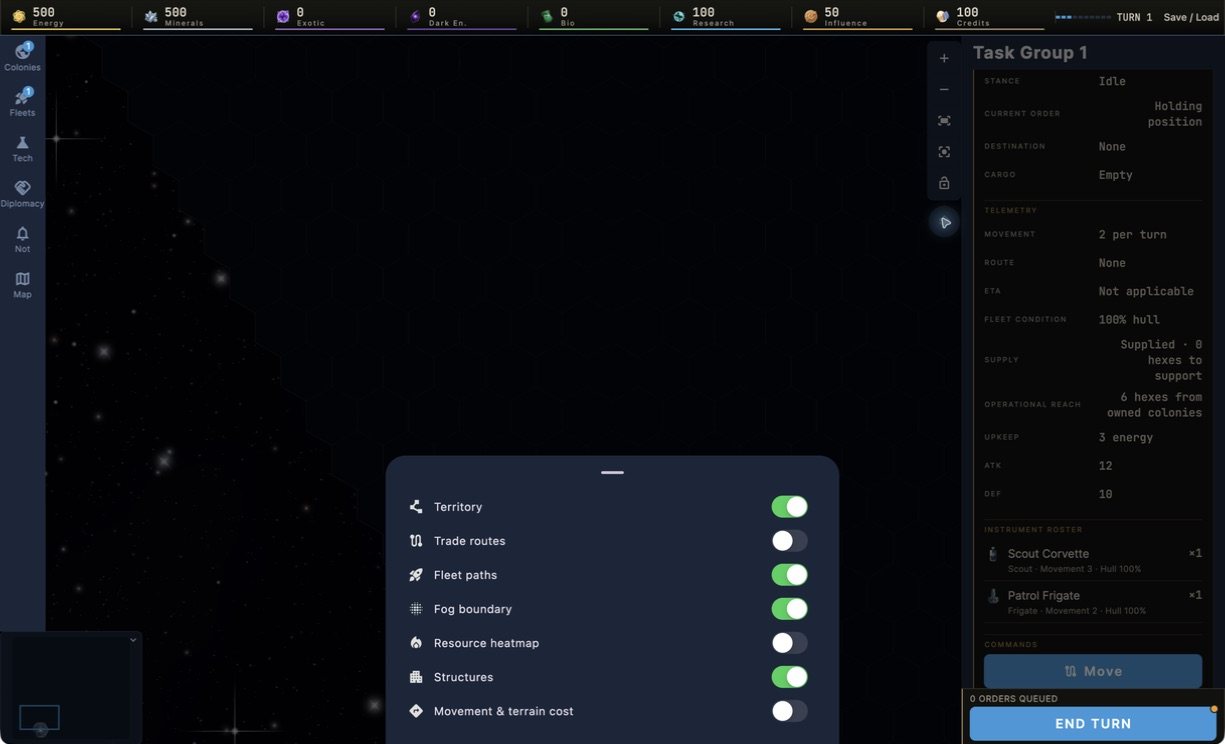
Two frames of the development build: the overlay sheet that changes what the map is telling you, and the same game in a small desktop window.
Ready to dig in?
The Player’s Guide walks you through your first turn, the eight resources, fleet combat, and asynchronous multiplayer.